
OEM Partners
White-label the entire platform. Your colours, your fonts, your brand. Customers see your product, not PIES.

There’s a compelling idea that public AI models are like having a country of geniuses in a data centre, working for your business. And it’s true — they’re extraordinary tools.
But here’s what that framing misses.
Every prompt your employees enter into a public LLM externalises organisational knowledge. Product plans. Customer insights. Pricing strategies. Confidential data. And because public AI providers have unclear data retention and training policies, businesses often have no visibility into where that information goes next.
We’ve seen this before. Shadow IT took years to create problems. Shadow AI is doing it in months.
The deeper issue: public AI platforms aren’t neutral tools. They’re externally controlled platforms with their own commercial incentives. You are not the customer. You are the input.
The alternative is AI sovereignty. A private LLM deployed behind your own firewall gives you the same capabilities — without surrendering your data, your governance, or your competitive advantage to someone else’s platform.
The question isn’t whether to use AI. It’s whether the AI you use works for you — or on you.



Train your own LLM. Customise every visual element. Your brand, your platform.

5 models from 3B to 400B parameters. Choose based on your hardware and needs.
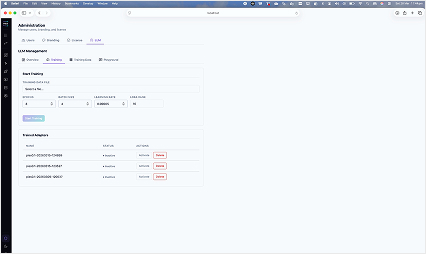
Train on your data. Configure epochs, batch size, learning rate. Manage trained adapters.
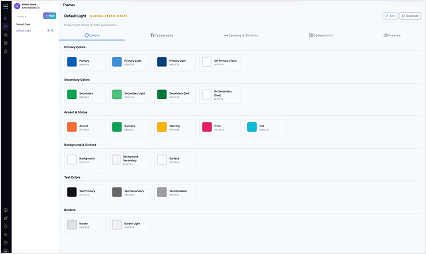
Full colour palette, typography, spacing control. White-label for OEM partners.

White-label the entire platform. Your colours, your fonts, your brand. Customers see your product, not PIES.

Demonstrate private AI as the differentiator vs OutSystems and Mendix. No competitor offers self-hosted LLM training.

GPU add-on creates an upsell path on every deal. Train-the-trainer on LLM management for your reseller network.
Open-source models like LLaMA can be fine-tuned on proprietary datasets, allowing them to perform better in specialised industries or workflows.
For example, an organisation can train a model specifically for:
Fine-tuned domain models often outperform general-purpose models on specialised tasks because they learn the vocabulary, context, and reasoning patterns of that domain.


This allows organisations to optimise the model for specific needs such as low latency, high throughput, or integration with internal systems.
It also enables deeper experimentation and innovation that may not be possible with closed APIs.
Running your own LLM removes that dependency and gives organisations long-term technological independence.
This is particularly important for companies building AI as a core product capability rather than just a feature.


API-based LLMs usually charge per request or per token. For applications with high volumes of usage, these costs can become substantial.
While self-hosting requires an initial investment in GPUs and infrastructure, the cost per request can become significantly lower over time once the infrastructure is in place.
When running models locally or within your own cloud environment, requests do not need to travel to external servers.
This reduces latency and enables faster real-time AI interactions, which is critical for:


become valuable intellectual property assets.
These assets can become a competitive advantage, especially when the model incorporates proprietary company knowledge.
This allows the AI to function as a core internal capability rather than an external service.


This can position the organisation as an AI-driven business, giving it long-term strategic advantages.
This allows the AI to function as a core internal capability rather than an external service.



Transform Your Requirements into Working Applications
Download