

AI governance
Every AI call: classified, redacted, routed by policy and on the record.
PIES Studio treats AI like any other enterprise system. A policy engine decides which model may see which data, your organisation's knowledge is governed at upload, agents act within approvals and budgets, and everything is signed into an audit log your security team can read.
The problem
Teams are already using AI on company data. Without governance there is no record of what left the building, which model saw it, or why it answered the way it did. Shadow AI is the default outcome.
What PIES does
Puts one policy engine in front of every AI request made by Studio, by agents and by the applications you build. The same engine, the same log, whether the model is in the cloud or on your own GPUs.
What you get
Model choice you can defend, data that is redacted before it is seen, agents that stay inside their lane, and an audit trail that answers the regulator's question without a forensic exercise.
How a request is governed
Seven steps, every time.
- 01
Request
A build, a chat question, an agent step or an end-user chatbot message arrives from a named user in a named app.
- 02
Classify
The request and its data are classified: PII, card data, health, internal, public. Knowledge Base content is classified at upload.
- 03
Redact
Card numbers, emails and other personal data in a request are masked before the model call, as the policy sets.
- 04
Route
The enabled policy chooses provider and model from request type, data class, role, app, region and tier. If no policy allows a model, the request fails. It never falls back to the cloud.
- 05
Answer
The chosen model answers. Heavy work is upgraded to the strongest model the policy already permits, so agents are never weaker than chat.
- 06
Score
Output can be checked for groundedness against its sources. Audit rows carry the verdict.
- 07
Record
Who, which model, data classes, tokens, cost, decision and agent attribution are signed into a hash-chained audit log.
Policy engine
A policy, not a picker, decides the model.
Policies combine six dimensions. Change one rule and every application, agent and chatbot follows it immediately. Nothing is rebuilt.
Request type
Build, chat, agent step, chatbot, completion. Route each differently.
Data classification
PII, card data, health, internal, public. Detected per request, not declared once.
Role and user
Who is asking. Governance roles are enforced on the server from the verified token.
Application
Policies scoped to one app or the whole organisation.
Region
Keep sovereign workloads on sovereign infrastructure.
Model tier
Small, mid or strong. Light edits locally, architecture on a frontier model.
Routing presets
Start from a posture, not a blank page.
Seven presets ship with Enterprise. Add one beside your own rules or replace the active set when your posture changes.
Air-Gapped
Only PIES LLM on your own hardware. No cloud provider is ever allowed.
Regulated Industry
HIPAA and PCI posture: redaction on, regulated data classes pinned to private models.
Public Sector / Sovereign
Region-pinned routing, private models for classified data, full audit retention.
Cost-Optimised Hybrid
Light work to your local model, heavy work to the cloud, with a savings panel that reports cloud spend avoided.
Hybrid Burst-and-Train
Cloud for peaks, private models for steady state, interactions kept for fine-tuning.
Frontier Quality
Best available model for every request, still redacted and recorded.
Default Balanced
Sensible mix for teams starting out. Replace it as your posture firms up.
Management tools
See what a policy will do before anyone feels it.
Test Console
Type a request as a user, app and region and see which policy matched, the classification, the model chosen and what was redacted. Change the policy and simulate again.
Shadow policies
Draft a policy and evaluate it only on simulate and replay. See what it would have done before it affects anyone.
Policy lint
Finds dead policies and shadowed rules so the active set stays understandable.
Budgets
Iterations, tokens and minutes per run and monthly token caps per agent. Runs compact their history as they approach the budget instead of stopping mid-task.
Provider health
AI Settings shows the real state of each key: rejected, out of credit, rate limited. Administrators see a banner before users feel it.
Cost visibility
Tokens in and out, latency and estimated cost on every audit row, with the top model and daily totals on the dashboard.
Private AI and hybrid
Keep it on your hardware, or split the work.
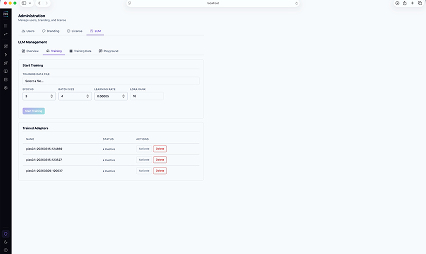
PIES LLM is included with every Enterprise licence and runs on your own GPUs, a rented pod, a VM in your tenancy or an Apple Silicon Mac. The licence is validated locally and weights can arrive on media for air-gapped sites.
- Air-Gapped preset: no cloud provider can be chosen
- Cost-Optimised Hybrid: light edits local, heavy work cloud, savings reported
- Decomposed builds: the cloud plans, the local model executes repetitive items
- Fine-tune on your own interactions and roll a model back
Knowledge and memory
Your organisation's knowledge is governed too.
Classified at upload
Knowledge Base documents are classified and masked when they arrive, so a policy can refuse to send regulated content to a cloud model.
Every change audited
Who added, edited or removed a source, and when. Knowledge used by a build or agent run is visible in its trace.
Memory you control
PIES AI Memory lists what it has learned about how your organisation builds. Read it, edit it, delete it. Nothing is hidden in a prompt.
Agent governance
Agents work inside the lane you draw.
Agents are the fastest way to get value from AI and the fastest way to lose control of it. In PIES every agent has an autonomy level, approvals, a budget and an access group, and every decision it makes is logged.
Autonomy per agent
Supervised: a person approves each step. Autonomous: within budget and guardrails. Locked down: read-only.
Approval cards
Allow, deny with a note, allow for the rest of the run, or always allow. Unanswered approvals time out and the run fails safe.
Runs as an access group
An agent acts as one of the app's access groups. The app enforces that group's permissions, including which tables it may read. Rows it writes are signed as the agent.
Decisions log
Every agent decision with who, outcome and payload. Filterable and exportable as CSV, paged for hundreds of thousands of rows.
Attribution in the hash
Audit rows carry agent, run and posted version, so what was running is never in doubt.
Run control
Pause, resume, steer, retry, skip or roll back any run from its control panel. Rewind any AI build turn.
Audit
Signed, chained, exportable.
Every governed call, including the in-app chatbot, is written to a hash-chained log. Tampering breaks the chain. Filter by user, app, agent, playbook, run, provider or decision, and trace from a run in Activity down to each call.
- User, app, provider, model, tokens in and out, latency and cost
- Data classes detected, redaction applied, policy matched, decision
- Factuality verdict where output was scored
- Agent, run and posted version inside the hash
- CSV export, Decisions log, application activity log with restore
Separation of duties
Eight governance roles, enforced on the server.
No single person can author a policy, approve it and audit it. Identity comes from the verified token, never from the request.
Compliance programmes
Built to support your controls.
Compliance packs are included with every Enterprise licence, covering common privacy, financial services, health, government and critical infrastructure control sets. The audit log, redaction, routing presets and separated roles give your assessors evidence rather than assurances. Ask us for the mapping to the frameworks you report against.
Questions your risk team will ask
What stops a developer using a cloud model on regulated data?
The policy. Model choice is not a picker in the UI; the enabled policy routes every request by data classification and if no policy allows a cloud model for that class the request fails rather than falling back.
Can we prove what the AI did six months ago?
Yes. Every governed call is in a signed, hash-chained log with user, app, model, data classes, tokens, cost and decision, exportable as CSV and traceable from the run in Activity to its individual calls.
Does this cover the chatbot our customers use inside the app?
Yes. The in-app chatbot goes through the same policy engine and the same audit log as builds and agents.
Can we run with no cloud provider at all?
Yes. The Air-Gapped preset allows only PIES LLM on your own hardware. The licence is validated locally and model weights can be delivered on media.
Who can change a policy?
Only users holding the policy author role, enforced on the server from the verified token. Approvers, auditors and compliance roles are separate, so no single person can author, approve and audit the same change.
How do we test a new policy without breaking anything?
Create it as a shadow policy. It is evaluated only on simulate and replay in the Test Console until you enable it.
Do agents get around any of this?
No. Agents run as an access group of the app, obey the same routing policies, carry their own budgets and approvals, and every step they take is in the Decisions log and the audit log.
See governance on your own data.
Start a 60-day Enterprise trial on your own servers. Policies, Test Console and the audit log are included.